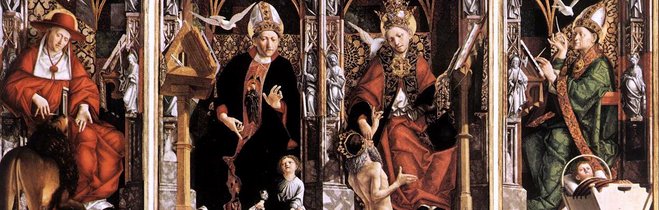
Sunday, May 27, 2007

Pentecost

Catena PDF.

A new Father makes an appearance for Pentecost, namely, Didymus the Blind, a contemporary of Athanasius and great defender of orthodoxy against Arianism. His comments offer profound theological insight into the workings of the different Persons of the Holy Trinity. Here is a sample:

But the Holy Ghost was another Comforter: differing not in nature, but in operation. For whereas our Savior in His office of Mediator, and of Messenger, and as High Priest, made supplication for our sins; the Holy Ghost is a Comforter in another sense, i.e. as consoling our griefs. But do not infer from the different operations of the Son and the Spirit, a difference of nature. For in other places we find the Holy Spirit performing the office of intercessor with the Father, as, The Spirit Himself intercedes for us (Romans 8:26). And the Savior, on the other hand, pours consolation into those hearts that need it: as in Maccabees, He strengthened those of the people that were brought low (1 Maccabees 14:15).
The Fathers wax eloquent today on the relation of love and the Holy Spirit. Here is St. Augustine in typically excellent dialectical form:
But when the love of God is shed abroad in our hearts by the Holy Ghost which is given unto us (Romans 5:5), how shall we love and keep the commandments of Christ, so as to receive the Spirit, when we are not able to love or to keep them, unless we have received the Spirit? Does love in us go first, i.e. do we love Christ and keep His commandments so as to deserve to receive the Holy Spirit, and to have the love of God the Father shed abroad in our hearts? This is a perverse opinion. For he who does not love the Father, does not love the Son, however he may think he does. It remains for us to understand, that he who loves has the Holy Spirit, and by having Him, attains to having more of Him, and by having more of Him, to loving more. The disciples had already the Spirit which our Lord promised; but they were to be given more of Him: they had Him secretly; they were to receive Him openly. The promise is made both to him who has the Spirit, and to him who has Him not: to the former, that he shall have Him; to the latter, that He shall have more of Him.

Sunday, May 6, 2007

Fifth Sunday of Easter

Although our class is on its summer break until the fall, I will continue to post the Catenas for the Sunday Gospels (and more besides).

This Sunday's Gospel from St. John hides a profundity of theological wisdom in its brevity. Only four verses long, this passage receives one of the lengthiest chain of commentaries. One can imagine St. Thomas reveling in the depths which just a few chosen Fathers reach in their reflections.

Much of the discussion is about the Son being glorified in the Father and the Father in the Son. Although Origen discusses guides us away from a mistaken sense of glory and toward a correct sense of the glory we hope to receive, there is no definition of the divine glory itself. So, here for your consideration is St. Thomas's definition as given in his Commentary on John's Gospel:

To be glorified is to be made illustrious. For glory is said to be a kind of brilliance. Thus, according to Ambrose, "glory is clear and manifest recognition with praise". This is why the Greek word for "make famous" is translated "glorify", and vice versa.
The divine glory therefore is that blessed, eternal and infinitely joyful recognition of divinity within the Holy Trinity.

Today's Catena: PDF for single-sided printing; for double-sided booklet printing.

Sunday, April 29, 2007

Paternal Presentations

For those who have been attending the course, I'm gradually uploading copies of my slide shows on various fathers. They'll be somewhat unintelligible for those who missed those particular classes, but perhaps not altogether so.

Fourth Sunday of Easter

The brief Gospel passage from St. John 10:27-30 provides the Fathers with ample reflection on the mystery of the Trinity and the heresies devised to confuse the faithful about it.

A PDF version of today's Catena may be found here.

Sunday, April 22, 2007

Third Sunday of Easter


John 21:1-19 is so vividly full of Christ's tenderness and love toward Peter that we can expect the Fathers to resonate with an uncommon depth. Here is St. Augustine:

Let us love therefore, not ourselves, but Him, and in feeding His sheep, seek not our own, but the things which are His. For whoever loves himself, not God, loves not himself. Man, who cannot live of himself, must die by loving himself; and he cannot love himself, who loves himself to his own destruction. Whereas when He by Whom we live is loved, we love ourselves the more.
And with typical (though unfortunately much overlooked) fervor for the rule of St. Peter, St. John Chrysostom says:
That which most of all attracts the Divine love is care and love for our neighbor. Our Lord passing by the rest, addresses this command to Peter: he being the chief of the Apostles, the mouth of the disciples, and head of the college. Our Lord remembers no more his sin in denying Him, or brings that as a charge against him, but commits to him at once the superintendence over his brethren. If you love Me, have rule over your brethren, show forth that love which you have evidenced throughout, and that life which you said you would lay down for Me, lay down for the sheep.
PDF files:
Booklet (for double-sided printing)
Letter sized (for single-sided printing)

Tuesday, April 17, 2007

The Holy Father and Our Holy Fathers

.- On the occasion of Pope Benedict XVI's 80th birthday, the director of the Holy See's Press Office, Father Federico Lombardi, said this week there are two issues of profound concern to Pope Benedict XVI: the continual reference to the fathers of the Church and the constant explication and living of the Sacred Liturgy.

"Two particular aspects call come to mind. First of all, the richness and the nature of the references to the Fathers of the Church. There hasn't been a break in the two thousand years since the Scriptures until today. One can see the continuity in the reflections and in the deepening of the faith throughout time from Jesus to today. The Fathers were somewhat eclipsed in the common culture of the believer, and now they have become more familiar," Father Lombardi said.

Friday, April 13, 2007

Second Sunday of Easter

Reflections from the Fathers this week emphasize the wonder-filled events of the resurrected Christ visiting his Apostles.