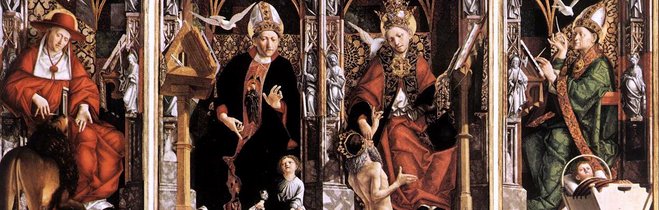
A beautiful catena for this feast of our Lord. It includes, as it were, a discussion among the Fathers about the need for Christ to be baptized, not of course on account of any sin of His. As Ambrose puts it: "Like a wise master teaching His doctrines as much by His own deeds as by His words, He Himself did what He commanded all His disciples to do." And the Fathers, both of the East and West, are all of one mind that Christ in hearing "You are my Son, the beloved," did not learn of His divinity then. As Augustine puts it, "Not that Christ was taught what He knew before, but they who stood by heard it, for whose sake the voice came."
Sunday, January 13, 2008

Sunday, January 6, 2008
Epiphany
This Catena is the longest yet by far and probably the richest in literal exegesis. Questions raised in the course of the commentary include, Were there only three in the Magis' company or is that a symbolic number? Where were they from? How did they get to Bethlehem so quickly if they were from far away? And many more.
Sunday, December 16, 2007
3rd Sunday of Advent
In this Sunday's Catena St. Thomas shows us what first appear to be contradictory interpretations of the Fathers on the passage about John the Baptist wanting to know if Christ was "the one who was to come". The apparent argument is over whether John was asking out of ignorance or a kind of Petrine disbelief or from some hidden purpose, or even whether John was referring to Christ's descent into hell. Through the confusion of interpretation Chrysostom shines consistently.
There is a story that when St. Thomas and some companions were approaching Paris and came to an overlook, one of the companions asked him if he too admired the obvious wealth and beauty of the city. St. Thomas replied that while Paris was indeed beautiful, he'd give it all away for a volume of Chrysostom on Matthew's Gospel.
Today we share a glimpse with St. Thomas of that grander view St. John Chrysostom offers us into the heavenly city.
Sunday, December 9, 2007
2nd Sunday of Advent
The catena for this Sunday's Gospel is by far the longest I've posted. One reason for this is the length the Fathers go to in meditating on and explaining the details of John the Baptist's life and character.
The translation of the Catena on Matthew seems better than the one on Luke. I've had to correct only a few egregious errors (e.g., fight for the correct flight) and revise fewer passages into smoother, dare I say, more felicitous English.
Sunday, December 2, 2007
First Sunday in Advent
In this Sunday's Catena we are introduced to two relatively late Fathers, namely, Rabanus Maurus, a 9th century Benedictine theologian, and Remigius of Auxerre, a 10th century Benedictine teacher. Although St. Thomas uses them only once each in today's Catena, unlike the frequently appearing Chrysostom or Augustine, nevertheless he certainly relied heavily upon their pioneering work of establishing the study of theology as a kind of science.
Sunday, November 25, 2007
Christ the King
The Catena for this Sunday's Gospel includes several Fathers discussing the correct interpretation of the passage about the good thief entering into Paradise. Some, according to St. John Chrysostom, argued that the passage proves there is no resurrection.
Sunday, November 18, 2007
33rd Sunday in Ordinary Time
The Fathers wax eloquent on the end times in this Catena for today's Gospel.
Once again I've had to make several important corrections in the Newman-team translation. For example, denuntiat gets translated as "denounces", when the clear (and ordinary) translation is "announces". Perhaps a 19th century denunciation was less derogatory than today's, but be that as it may, we have certainly lost the sense of the original when the translation reads:
"God denounces the woes that shall forerun the destruction of the world...."Here is the original:
Perituri mundi praecurrentia mala denuntiat Dominus....Here is my translation:
"The Lord makes known the evils that will come before the end of the world...."This is just one of many corrections I've had to make in today's selection.
The Catena Aurea is a work of incredible genius that can be of invaluable help in reconnecting us orphans with our Fathers in faith--if they're allowed to speak to us in our language.
Subscribe to:
Posts (Atom)


